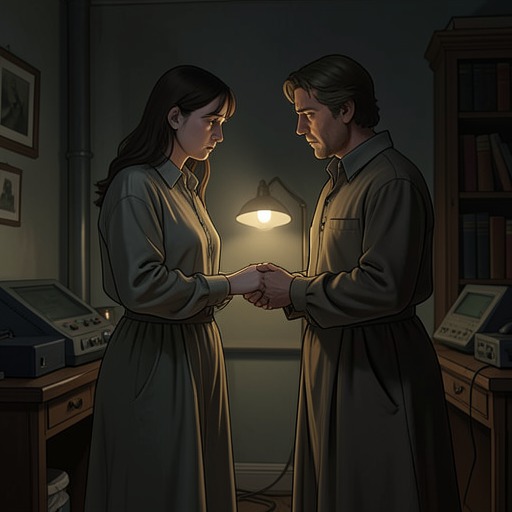
Katherine Wentworth Sexton
Deception PointKatherine Wentworth Sexton is Rachel Sexton’s mother and the only immediate family member Rachel loses before the novel’s present-day events. Resilient and devoted to her daughter, she endures a miserable marriage to Sedgewick Sexton without surrendering her principles. Her fatal drive home from Thanksgiving dinner, after her husband has chosen to stay away, leaves Rachel with grief and anger that shape her relationship with her father for years afterward.
Marriage and Family
Katherine is married to Senator Sedgewick Sexton, whose long-running infidelities are discreet but not unknown to her. Rachel understands that her mother is no fool: Sedgewick’s affairs come wrapped in persuasive alibis and wounded indignation at the suggestion of betrayal. Katherine nevertheless turns a blind eye, telling Rachel that she has given her a beautiful daughter and that her husband will answer for his actions to a higher power. Rachel urges her to consider divorce, but Katherine holds to her promise of marriage until death. The narration presents this fidelity not as ignorance of the truth but as a deliberate, costly commitment.
Katherine’s importance to Rachel is sharpened by the fact that she is Rachel’s only immediate family. The marriage that Rachel experiences as a source of deceit and pain is also the setting in which her mother remains a steady, loving presence. After Katherine’s death, Rachel sees her mother’s release from the despair of that marriage as an ironic mercy, even as the loss devastates her.
A Mother-Daughter Bond
Katherine’s resilience appears in the memories Rachel carries of their time together. When Rachel was seven, she fell through the ice of a frozen pond while skating and was trapped underwater, convinced she would die. Katherine’s powerful grasp pulled her to safety. The incident left Rachel with a persistent fear of open water, especially cold water, but it also fixes her mother in memory as the person who physically brought her back from danger.
Six years before the present-day journey, Katherine persuaded Rachel to join her on an Alaskan cruise. Rachel proposed land-based alternatives, but her mother insisted that her daughter would have to learn to deal with the fact that much of the planet was covered by water. The cruise was the last trip they took together. As Rachel flies over the Arctic Ocean, the sight of icebergs summons both that journey and the loneliness of losing the person who had once rescued her from the water.
The Last Thanksgiving
Katherine’s final holiday begins with separation. Snowbound at O’Hare airport on Thanksgiving morning, Rachel phones home and apologizes that the family will spend the day apart. Katherine says she had been looking forward to seeing her. She then explains that Sedgewick has decided to remain in his Washington, D.C., suite, claiming he is exhausted and needs to catch up on work. Rachel is furious: the Senate is not in session, and her father is less than two hours away. She suspects that his excuse conceals another affair and is sickened by the prospect of her mother spending Thanksgiving alone.
Katherine responds practically rather than allowing the meal to go to waste. She decides to drive it to Aunt Ann’s, who has always invited the family for Thanksgiving, and says she will call her. Rachel, still feeling guilty, promises to come home as soon as she can. Their exchange closes with Katherine wishing her daughter a safe flight, an ordinary expression of care made consequential by what follows.
At 10:30 that night, Rachel’s taxi reaches the Sexton estate to find police cars, news vans, and every light on. A Virginia State policeman tells her that freezing rain made Route Twenty-five slick; Katherine’s car left the road and went into a wooded ravine. She died on impact. The fatal crash turns the practical decision to bring the holiday food to relatives into the last action of Katherine’s life recorded in Rachel’s memories.
Death and Aftermath
Sedgewick returns after receiving the news and holds a small press conference in the living room. He tells the media that his wife died in a crash while returning from Thanksgiving dinner with family, and says he wishes he had been home because the accident would never have happened otherwise. Rachel stands in the wings, sobbing. His public expression of regret does not reconcile her to him; it deepens her loathing, because his absence from the holiday is the immediate circumstance she cannot forget.
From that moment, Rachel emotionally separates herself from her father in a way her mother never did. Sedgewick barely seems to notice. He soon uses his late wife’s fortune to pursue his party’s presidential nomination, while the sympathy vote helps his political prospects. Katherine’s death therefore has consequences beyond Rachel’s private grief: it becomes entangled with her husband’s public ambition, and Rachel sees her mother’s loss treated as political advantage.
Three years later, Sedgewick’s campaign continues to shape Rachel’s life from a distance. She postpones her hopes of meeting a man and starting a family, finding it easier to withdraw from social life than to face Washington suitors eager to pursue a grieving woman who might become a first daughter. Katherine remains present in the narrative through these aftereffects: the rescue, the last shared trip, the abandoned Thanksgiving, and Rachel’s knowledge that her mother endured a marriage from which death finally released her. Her brief appearance in the remembered past thus explains both the depth of Rachel’s bereavement and the lasting rupture between Rachel and her father.